

In this edition of our Origin Exploration series, we’re going to take a look at Vietnam and what it can offer the world from a coffee perspective.
Now, it’s fair to say that from a speciality perspective, Vietnamese coffee has not been high on the for many roasters of late, but as a player in the field, Vietnam produces a vast amount of coffee, and with a lot of focus and attention on producing ‘speciality robusta’, things are starting to turn a corner for Vietnamese coffee producers, and there’s some pretty decent coffee emerging from the second largest coffee production origin now. So let’s take a look.
It all started with a seed planted by colonialism (1857)
True story, coffee is not native to Vietnam. The story of coffee in Vietnam begins way back in 1857, when a French Catholic priest – Father Alexandre Vallet – brought a single Arabica tree to the country’s northern region. Vietnam had officially become a French colony the following year, and it wasn’t long before the colonial government saw the country’s warm, humid climate as a golden opportunity for agricultural exploitation.
By the 1880s and 1890s, French colonists were cultivating coffee on plantations, initially in the provinces of Ninh Bình, Quảng Bình, and later in the Annam region. These early efforts focused on Arabica beans. But Arabica proved difficult. It was fussy about altitude, susceptible to disease, and such a slow grower in the lowland terrain. Yields were modest, and the crop was never the juggernaut the colonists had hoped for. Back to the drawing board.
Where the real turning point came was in the early 1900s when Robusta (coffea canepohora) arrived from French and Belgian colonies in central Africa. Here is where coffee growing really changed in Vietnam, all a sudden it was able to survive and thrive in the conditions and before long started producing vast amounts of coffee, and far quicker reproduction than its cousin Arabica (coffea arabica) counterpart ever did.
It was exhibited at the 1900 Paris Exposition, and as a result the Robusta variety was a revelation, and for the Central Highlands of Vietnam – fertile, elevated, and climatically ideal – Robusta was a perfect match.
The rise of Robusta – Establishing Vietnam’s coffee country.
The Central Highlands became the engine of Vietnamese coffee production, and still remain so today. The region’s volcanic red basalt soil, known locally as Bazen Red Land, creates ideal conditions for coffee cultivation. Its rich mineral content, combined with highland elevation, allows coffee cherries to develop slowly and evenly, producing beans with depth and complexity.
The main growing provinces include:
- Dak Lak – the heart of Vietnam’s coffee industry, home to the city of Buôn Ma Thuột, often called the “Coffee Capital” of Vietnam.
- Lam Dong – the primary region for Arabica cultivation, particularly around the cooler, higher-altitude city of Đà Lạt.
- Gia Lai – known for strong, rich-flavoured beans with a complex sweet-sour profile.
- Son La – an emerging region in the northwest, gaining recognition for specialty Arabica production.
Growing environments
Just as it started, most Vietnamese coffee is still grown on small landholdings to this day, usually of around one to five acres. Farmers typically grow seedlings in nurseries before planting, and shade-growing is common. Taller trees such as avocado, jackfruit, durian, and pepper are planted alongside coffee to protect plants from direct sun and retain soil moisture and regular weeding, pruning of diseased branches, and selective harvesting are all part of traditional smallholder practice.
Arabica vs Robusta: A defining shift for Vietnam
A devastating outbreak of coffee leaf rust in the 1950s sealed Robusta’s dominance in Vietnam. The disease ravaged Arabica crops, and farmers pivoted almost entirely to the hardier, more productive Robusta variety. Today, Robusta accounts for around 97% of all coffee grown in Vietnam.
Why has Robusta been so dominant? The reasons are largely practical:
- Yield – Robusta can produce nearly double the output of Arabica per hectare.
- Resilience – it grows at lower altitudes and tolerates harsher conditions.
- Caffeine – Robusta contains roughly double the caffeine of Arabica (around 2.7% versus 1.5%), making it powerfully stimulating.
- Economics – state agricultural policy historically encouraged Robusta production for export.
That said, Arabica is staging a quiet comeback. A new generation of specialty producers in Lam Dong and Son La are working with single-origin Arabica beans, applying light-roast techniques and precision processing to compete with the premium coffees of Colombia and Ethiopia. The two traditions now coexist: bold Robusta for the masses, refined Arabica for the growing specialty market.
War, reform, and boom – a story of true resilience.
When we look at the timeline, It’s not been an easy ride for the Vietnam’s coffee industry, which has seen it repeatedly reshaped over the years. The Vietnam War severely disrupted production in the Central Highlands, and by the time the war had ended in 1975 agriculture was collectivised under the new government, private enterprise was restricted, and as a result coffee production had completely stalled in Vietnam.
It took nearly 10 years for coffee production to fully pick up again in Vietnam, and between 1986 and 1996, coffee-producing areas expanded at roughly 21% per year – one of the most dramatic agricultural growth stories of the 20th century.
By the late 1990s, Vietnam had overtaken Colombia to become the world’s second-largest coffee producer, behind only Brazil. Today, the country accounts for around 20% of global coffee production and a remarkable 40% of the world’s Robusta supply, exporting over 1.6 million metric tons annually.
An estimated 3 million people depend on the coffee industry for their livelihoods. Just let those numbers sink in for a moment.
Processing and roasting – the Vietnamese way
Processing
Once harvested, Vietnamese coffee cherries are typically processed using the dry (natural) method – the fruit is spread out to dry in the sun, allowing the bean inside to absorb sweetness from the drying pulp. Some producers use wet processing (washing the cherry before drying) for a cleaner, brighter cup, though this is more common with Arabica.
Similarly when it comes to Speciality Robusta an extended processing method has been developed known as the ‘Wet Polished’ process. This occurs after the initial processing, the hulled coffee beans are placed into a high-pressure pump system that continuously sprays mist to create mutual friction between the beans. This friction peels off the remaining silverskin, making the surface more glossy and ‘polished’. Once sufficient polishing is complete, a post-friction cooling process is carried out to preserve the quality of the coffee. The result of this additional processing produces a much cleaner coffee, one that’s freer of impurities, and more uniformed.
Roasting
When it comes to roasting coffee in Vietnam, well this is where things take a particularly distinctive turn. Squeamish coffee purists turn away here as we’re about to go down a pretty horrific path for a spell.
So the traditional ‘Nanyang’ roasting process in Vietnam sees coffee beans being roasted in a giant pan over a live fire. During the roast process a caramel-like mixture of sugar, vanilla, and sometimes cocoa or butter is added and folded into the beans to create a mixture akin to baked beans. Once dropped the virtually black mixture is laid out in metal trays to cool. Once cool the mixture will set in a bark-like form. The bark mixture is broken up and then milled through a grinder for brewing. The result of this technique gives the beans a slightly sweet taste, with a glossy exterior and a rich, smokey flavour.
In a more modern approach today, many roasters in Vietnam will use butter for a more even roast, which can produce a slightly oily texture in the finished cup. The result is a coffee that’s bold, dark, and intensely aromatic.
Here is a quick YouTube video showing an authentic Nanyang roasting process so you can get an idea of it in action:
Vietnamese coffee across the globe
With the coffee production in Vietnam being so vast it puts them in a prime spot as a prime supplier for export. Key export markets include Germany, the United States, Italy, Japan, and Spain, though Asian markets like China, South Korea, the Philippines, and Indonesia are growing rapidly and paying premium prices.
Instant Coffee
Vietnam’s robusta has long supplied instant and bulk blends worldwide, forming the backbone of products from Nescafé to store-brand ground coffee. Nestlé itself has a factory in Dong Nai province, which produces coffee for brands like Nescafé, Nespresso, and Starbucks products for export to over 35 countries. Which in practical terms means that an enormous proportion of the world’s instant coffee, espresso blends, and supermarket coffee contains Vietnamese coffee.
Robusta – the authentic espresso lover’s dream
If you’ve ever had an authentic Italian espresso, you’ll know it has a rich dark taste, a super creamy texture and a crema to die for, this style of coffee is where Robusta really flourishes and add extra depth and clarity to the cup. A typical Italian espresso will contain around at least 20 – 50% of Robusta beans, sometimes more. Robusta responds to the intenser, darker roasting required for an Italian style roast, and rather than hinder the flavours like you’d find from roasting an Arabica coffee the same way, it often adds sweetness and ‘roastiness’ to the overall cup.
Brewing with the Phin filter
No discussion of Vietnamese coffee is complete without the phin – a deceptively simple, four-piece metal drip filter that sits atop a glass and produces the country’s signature brew.
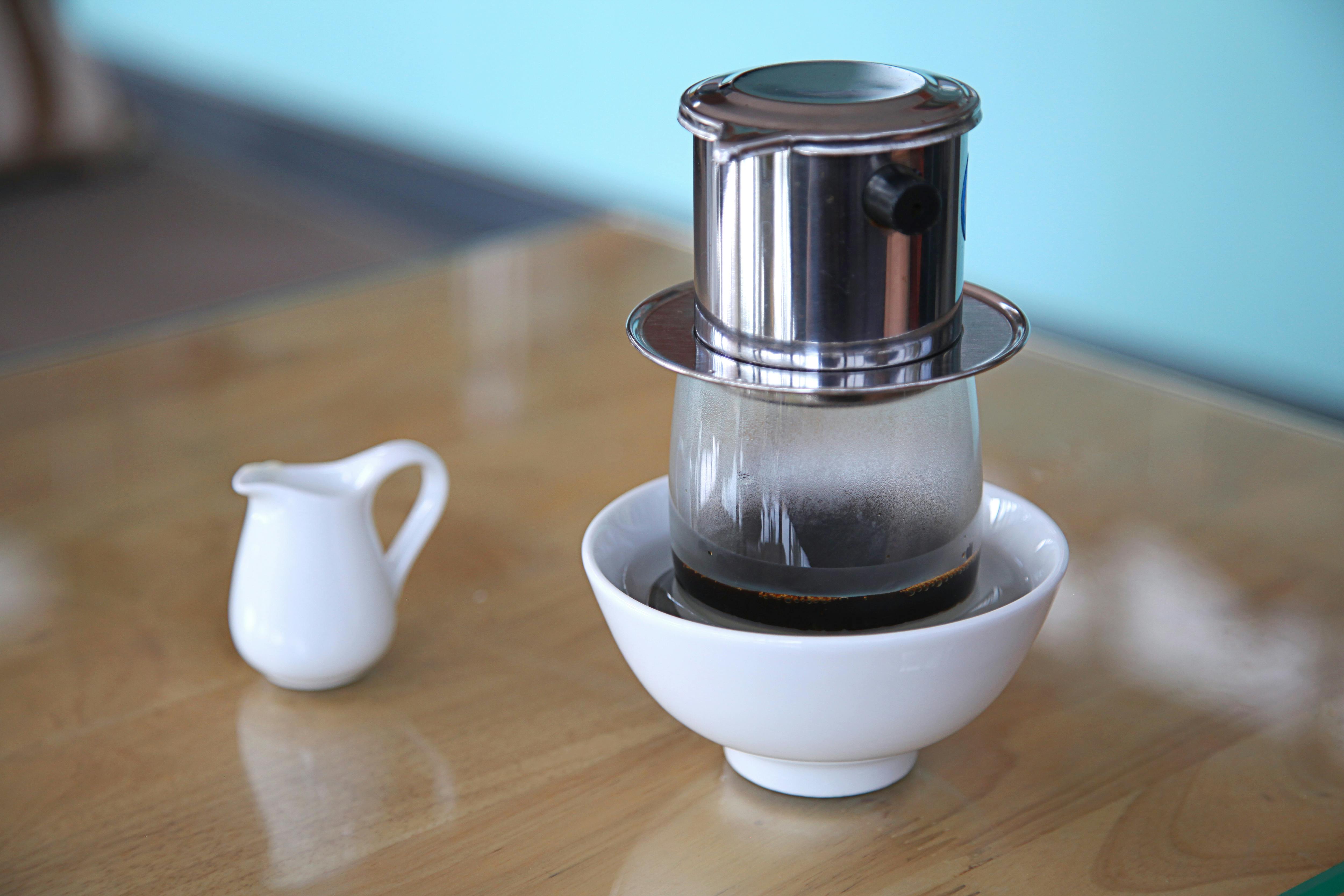
The phin consists of a small perforated plate (the base), a brewing chamber, a press to compact the coffee grounds, and a lid that doubles as a saucer. Coarsely ground coffee is packed loosely into the chamber, a small amount of hot water is added to bloom the grounds, and then the chamber is filled. The coffee drips slowly into the glass below over the course of four to six minutes.
This unhurried process is not a flaw – it’s a feature. The phin forces you to pause, to wait, and to be present. It is, in many ways, a physical embodiment of Vietnamese coffee culture itself.
Vietnamese coffee culture – Slow, social, and deep-rooted.
In Vietnam, coffee is far more than a morning caffeine hit. It is a social institution – a daily ritual of connection, conversation, and deliberate slowness.
All over the country, particularly in Hanoi, you’ll find open-air street cafés with tiny plastic stools spilling onto the pavement. Locals arrive early, order a cà phê sữa đá (iced coffee with condensed milk) or a cà phê đen (black coffee), and settle in – sometimes for hours. They read the paper, play chess, watch the scooters weave past, and indulge in what Vietnamese call bà tám: a lovely word for gossip, chatter, the easy conversation of people at leisure.
Condensed milk is central to this tradition, and its origins are practical. Fresh dairy was scarce and difficult to store in Vietnam’s tropical heat, particularly in the mid-20th century. Sweetened condensed milk – shelf-stable and intensely creamy – filled the gap and became so embedded in the culture that it’s now inseparable from the flavour identity of Vietnamese coffee.
Exploring Vietnam’s iconic coffee variations
Vietnamese coffee culture has always been inventive, turning scarcity and abundance alike into something memorable. The result is a canon of drinks unlike anything in the coffee world:
Cà phê sữa đá – The classic. Strong Robusta drip coffee poured over sweetened condensed milk and ice. Bold, sweet, cold, and utterly refreshing.
Cà phê trứng (Egg Coffee) – Born in Hanoi in the 1940s when milk was rationed, egg coffee was invented at the now-famous Café Giang. Egg yolk is whipped with condensed milk and sugar into a thick, custardy foam, which floats atop a small, strong cup of coffee. The result is somewhere between a dessert and a drink – rich, sweet, and deeply comforting.
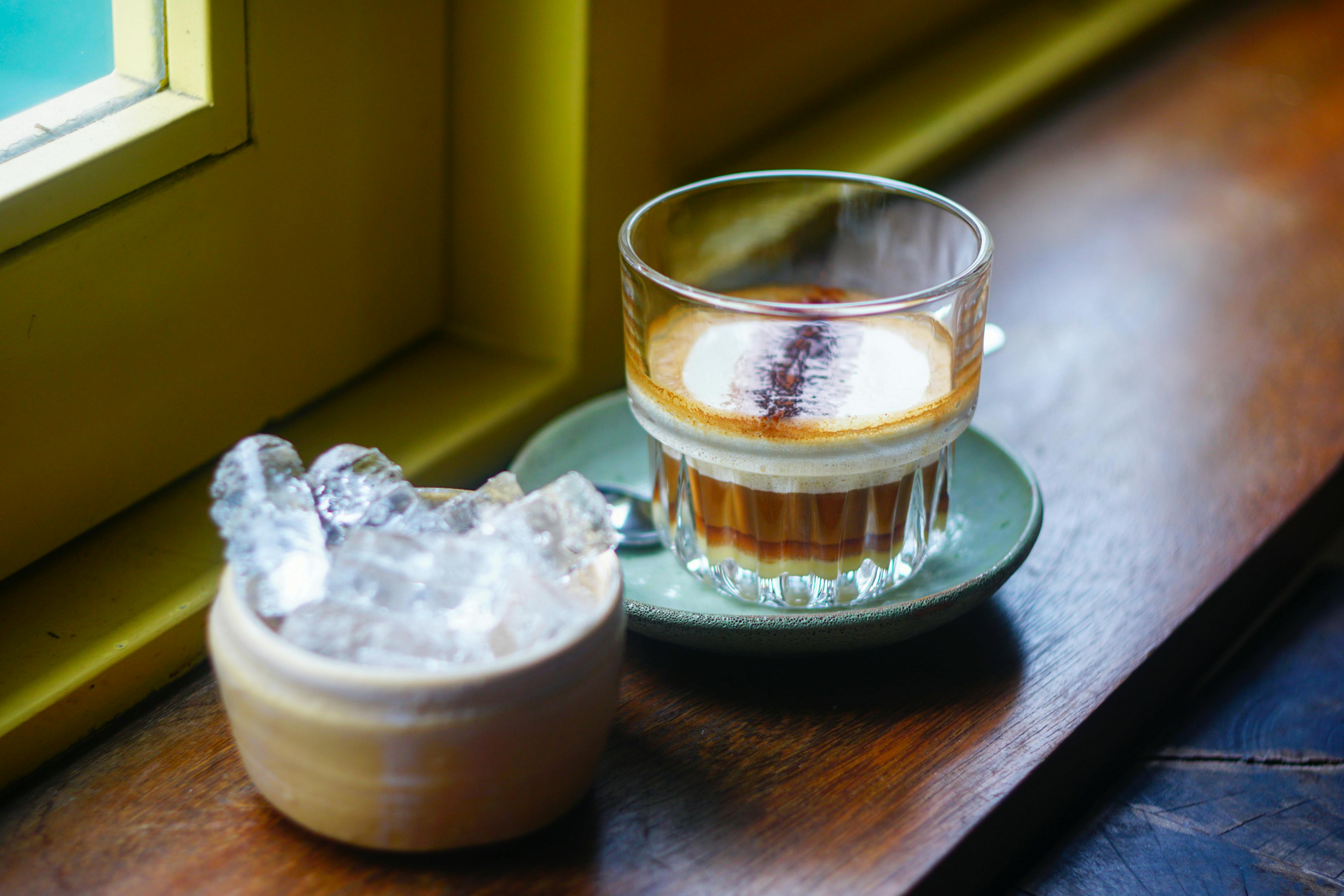
Cà phê cốt dừa (Coconut Coffee) – A favourite in Hanoi and across the south, coconut coffee blends condensed milk, coconut cream or coconut milk, and ice with a shot of strong coffee. It drinks like a coffee coconut smoothie – tropical, iced, and addictive.
Cà phê sữa chua (Yogurt Coffee) – A surprising combination born from French-introduced yogurt culture, this drink layers black coffee over plain yogurt and condensed milk. Tangy, creamy, and surprisingly refreshing on a hot day.
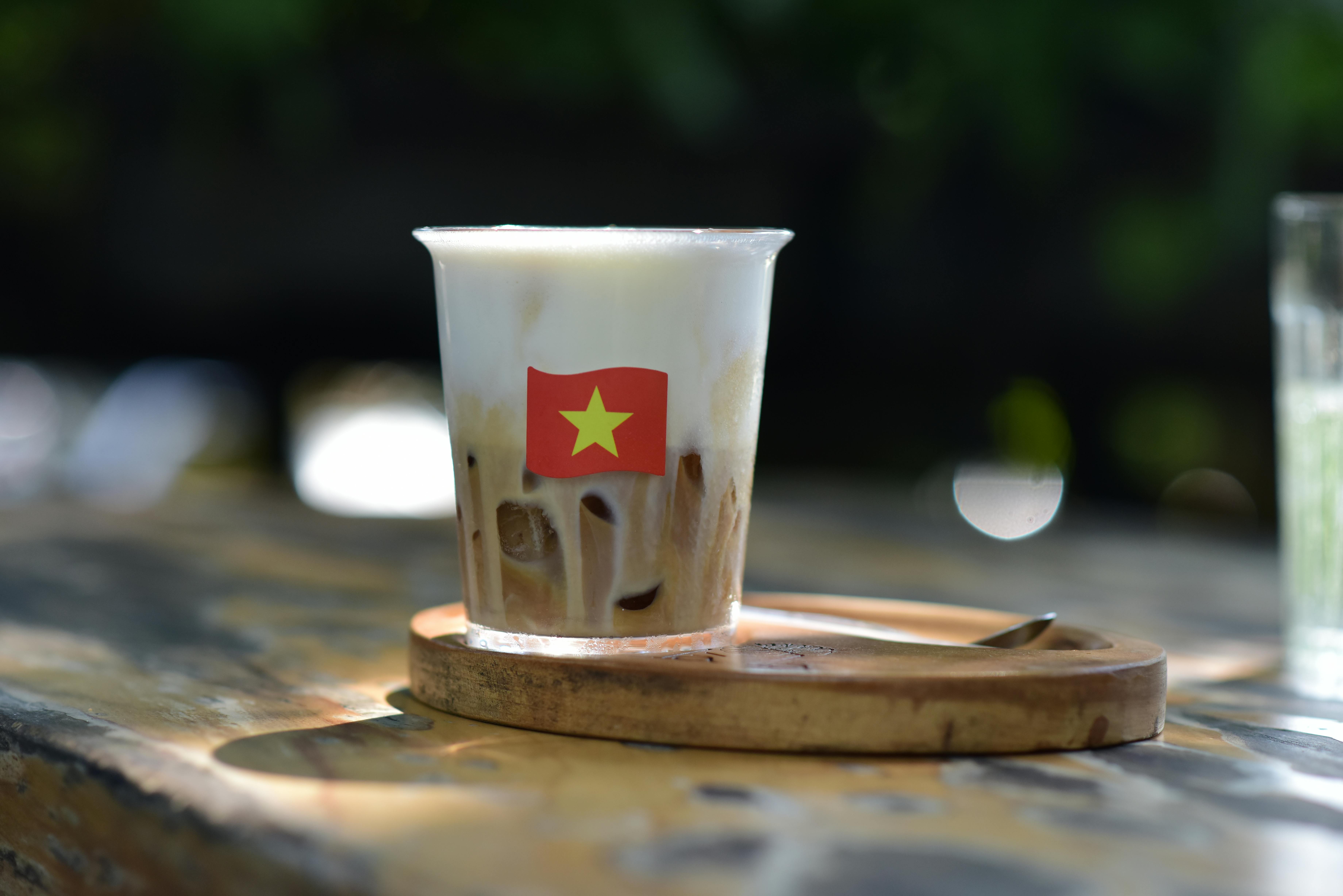
Cà phê muối (Salt Coffee) – A newer invention from Da Nang, where a small pinch of salt is added to the condensed milk base to enhance the coffee’s natural sweetness and reduce bitterness. Simple and oddly revelatory.
A Final Sip
So there we have it, a full-bodied exploration into the world of coffee according to Vietnam. So whilst it hasn’t held much weight for the speciality market here in the UK, it’s fair to say Vietnam is a serious player in the coffee world, not just for its coffee production, but also for its culture and creatively different drinking and roasting experiences, and an origin they’ve really created their own unique coffee experience.
If you ever find yourself in Vietnam – or even an authentic Vietnemese cafe order yourself a cà phê sữa đá and watch it drip slowly through a phin into a glass of condensed milk, you’re not just drinking coffee, you’re sipping the result of nearly 170 years of unique coffee history – bitter and sweet in equal measure, and worth every slow, deliberate drop.